

I recently had a conversation with a customer about the provenance of our vintage Armagnac. The gist of the conversation was about how we could guarantee that the vintage Armagnac he was purchasing from Fareham Wine Cellar was genuine and that it is actually from the vintage on the label.
Of course, I have been asked the question before and I am normally able to answer most questions sufficiently, but this time I thought I would try and delve a bit further. After all, most people who are buying vintage Armagnac are buying it as a gift – it is usually a one-off transaction with us, perhaps online, and therefore it is not like we have a long relationship with the customer. However, we do have a long and trusting relationships with our suppliers.
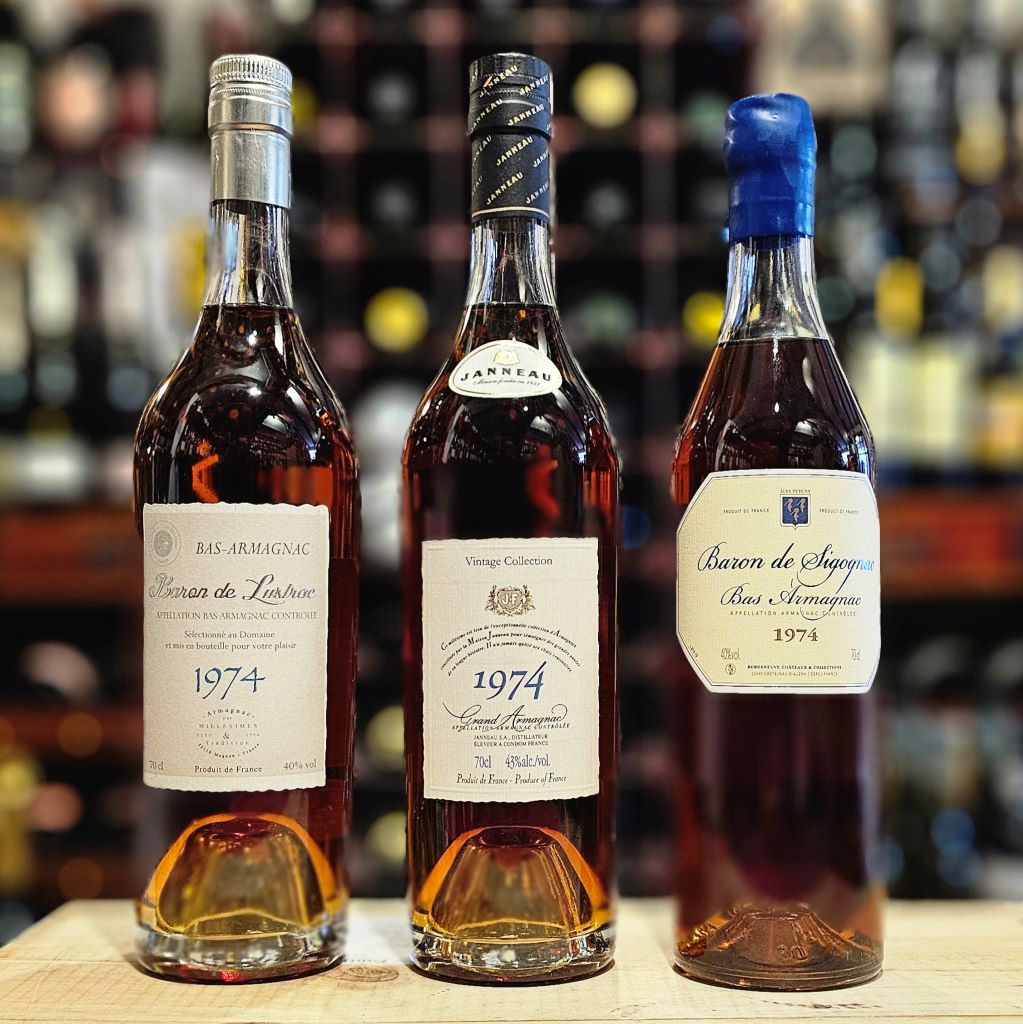
At Fareham Wine Cellar we sell vintage Armagnac principally from two of the main specialists in producing, sourcing and bottling older vintage Armagnac, Baron de Sigognac and Baron de Lustrac. We also sell smaller amounts of brandy from Domaine Boingneres and from Armagnac Janneau. We buy all of these directly from their appointed UK agents, Marussia Beverages UK Ltd. for Baron de Lustrac, Baron de Sigognac and Domaine Boigneres, and John E Fells for Janneau. We have been buying spirits from Eaux de Vie for nearly 20 years, and they have been dealing directly with the Armagnac houses for longer than that. John E Fells and Janneau are long-established companies. So I think it is safe to assume that all of the Armagnac we supply is directly sourced through the correct channels.
You don’t just need to take my word for it though!
In Armagnac there is a regulatory body called Le Bureau National Interprofessionnel de l’Armagnac (BNIA) which regulates all aspects of Armagnac production from distillation, through to ageing and bottling. The BNIA groups together all Armagnac professionals including independent or co-operative producers, negociants (ageing and trading), distillers and brokers. Their mission, from the BNIA website, is to,
Perhaps this is succinctly summed up best by Neil Mathieson, Managing Director of Marussia Beverages UK Ltd, in a recent email,
“I believe it is all very simple and quite strict! The totals of Armagnac held by every stock holder within the region are registered to the centilitre with the BNIA… …this includes if they are in glass or tank (so no further loss) or in wood (liable to evaporation at the standard allowed rate). Depletions, i.e. stock movements to another registered holder or bottlings are registered on a monthly basis and the figures adjusted. The BNIA and Excise (DGCCRF) division for fraud then conduct internal audit on stockholders; any differences could lead to automatic reduction of all vintage or nominal aged stock to 10 (ten years old).”
So there you have it. Vintage Armagnac has to be accounted for to the centilitre (10ml) by both the BNIA and French Excise / Customs. The penalty for fraud is for a producer to have all their vintage Armagnac recategorised as 10 Year Old Armagnac – a massive financial penalty. I think you might agree that this would be the end of the road for any such producer.
I hope this answers any questions that you might have about the regulation of vintage Armagnac but please do feel free to contact me if you have any further questions. Please browse our list of Vintage Armagnacs and see if we have one from your birth year! You can be safe in the knowledge that any bottle of Vintage Armagnac that you do buy from Fareham Wine Cellar is the genuine article.
Every centilitre of vintage Armagnac held by a producer is strictly audited and registered with the BNIA (Bureau National Interprofessionnel de l’Armagnac) and French Excise. Stocks are tracked continuously from distillation to bottling, ensuring absolute vintage authenticity before release.
By the time you purchase a Vintage Armagnac from Fareham Wine Cellar, the spirit will have been quietly ageing in oak barrels, and perhaps later transferred to glass demijohns, for many years following distillation. It remains in Gascony until it is bottled to order for our UK agents. Most of the Vintage Armagnacs we supply will have been bottled within the last 18 months, it is completely normal for a decades-old vintage to arrive with a pristine bottle, label, and cork.
We source our vintage Armagnacs directly from long-established official UK agents, including Eaux de Vie (Marussia Beverages UK) and John E Fells. We work with leading specialists like Baron de Sigognac, Baron de Lustrac, Domaine Boingnères, and Janneau.
No. Unlike fine wine, high-proof spirits like Armagnac do not age or improve once bottled. Once sealed in glass, the spirit remains stable and preserves its exact character, maturity, and flavour profile indefinitely if stored upright and out of direct sunlight.
Related Posts
Vintage Armagnac: Your Essential FAQs