

One of the questions I am often asked is, “Why is there a blob of white paint on my bottle of Vintage Port”? Indeed, some customers refuse to buy a bottle with white paint on it.
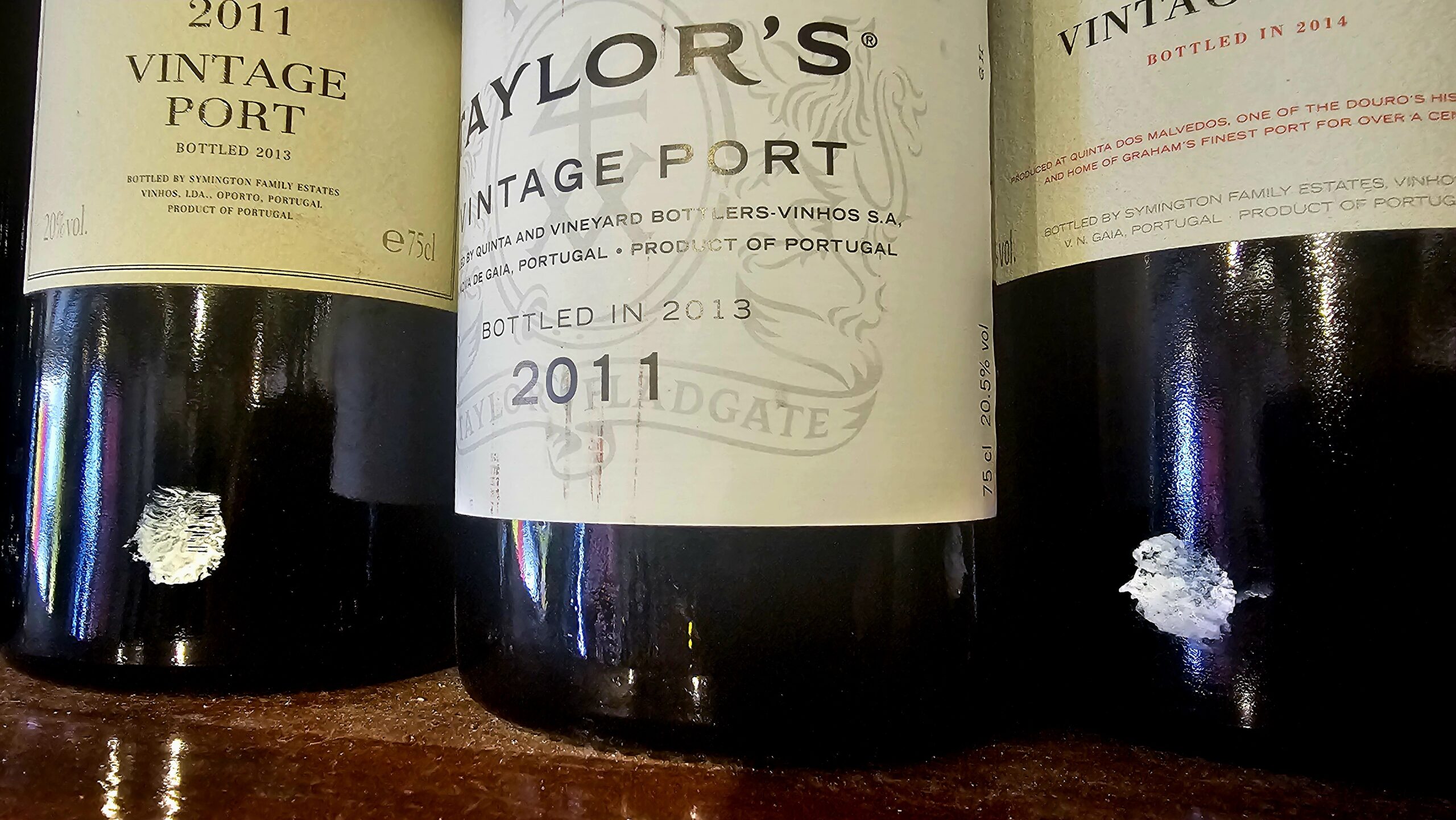
The white mark on many bottles of Vintage Port is commonly known as a “splash mark” (also called a chalk mark, paint daub, or whitewash mark). It consists of a simple dash, blob, or streak of white paint, chalk, or whitewash applied by hand in the Port lodges (cellars) of Vila Nova de Gaia, near Porto (Oporto), Portugal – where most Vintage Ports are bottled and matured after their initial ageing in the Douro Valley.
The appearance varies: sometimes it’s a neat, deliberate blob; other times it’s a more haphazard splash. This inconsistency often depends on the individual Port house (shipper), the specific cellar practices, and even the worker who applied it on that day, whether they were in a rush or taking extra care!

The white splash mark (also called a chalk mark, daub, or paint mark) on many bottles of Vintage Port indicates which side was uppermost during storage in the cellar.
Vintage Port forms a natural sediment (known as “crust”) over time as it ages in the bottle. When stored horizontally for long periods, this sediment settles along the lower side of the bottle. The splash mark – applied by cellar workers to the top-facing side – serves as a visual guide to maintain consistent orientation. Keeping the mark uppermost ensures the sediment remains settled on the opposite (bottom) side, reducing the risk of disturbing it when the bottle is moved, stood upright for decanting, or handled.
For consumers, the white splash mark (also called a chalk mark or paint daub) on many older bottles of Vintage Port provides useful guidance when it’s time to decant that special bottle.
Before the 1977 vintage, Vintage Port wasn’t legally required to carry a full label on the bottle itself. The Port vintage and producer details were often only on the capsule and cork. Without a visible label to indicate orientation, the white mark served as a practical indicator of how the bottle had been stored in the cellar.
Cellar workers applied the splash mark to the uppermost side of the bottle during horizontal storage. This ensured the sediment (or “crust”) settled on the opposite (lower) side. When handling or decanting the bottle, keeping the white mark facing upwards helps minimise disturbance to the sediment, allowing it to stay settled at the bottom rather than mixing back into the wine.
I refer to this as “was useful” because the practice feels a bit like a throwback to earlier times. In the past, bottles were often taken directly from the cellar, decanted immediately, and served, sometimes using a traditional Port cradle.
While the mark is still found on many older vintages, it’s less common on more recent bottles, and modern handling (standing upright for days beforehand) makes it less critical, though it remains a charming tradition for those who appreciate Vintage Port’s heritage.
Read our “Guide To Decanting Port”.
Why do some Vintage Port bottles have white paint, but others don’t? It’s a traditional marker for storage orientation, mainly on older vintages. Newer bottles often skip it due to better labelling and handling practices.
Is the white paint harmful or edible? No, it is a non-toxic whitewash, chalk or paint applied externally.
What if my bottle has no white mark? How should I store it? Store horizontally with the label facing up to keep the cork moist and sediment in one place (assuming standard modern labelling).
Does the splash mark indicate anything about the quality or vintage? No. It is purely functional for storage, not a sign of quality, age or vintage declaration.
Can I remove the white paint? Yes, it is normally pretty easy to wipe off with a damp cloth. Some collectors prefer to leave it as part of the bottle’s history.
Why do some people dislike bottles with the mark? A few customers find it “messy” or assume it’s a defect, but it’s a sign of authentic, traditionally handled Vintage Port.