
| Origin | |
|---|---|
| Main grapes | |
| Other grapes | |
| Vintage | |
| Bottle sizes | |
| Viticulture |
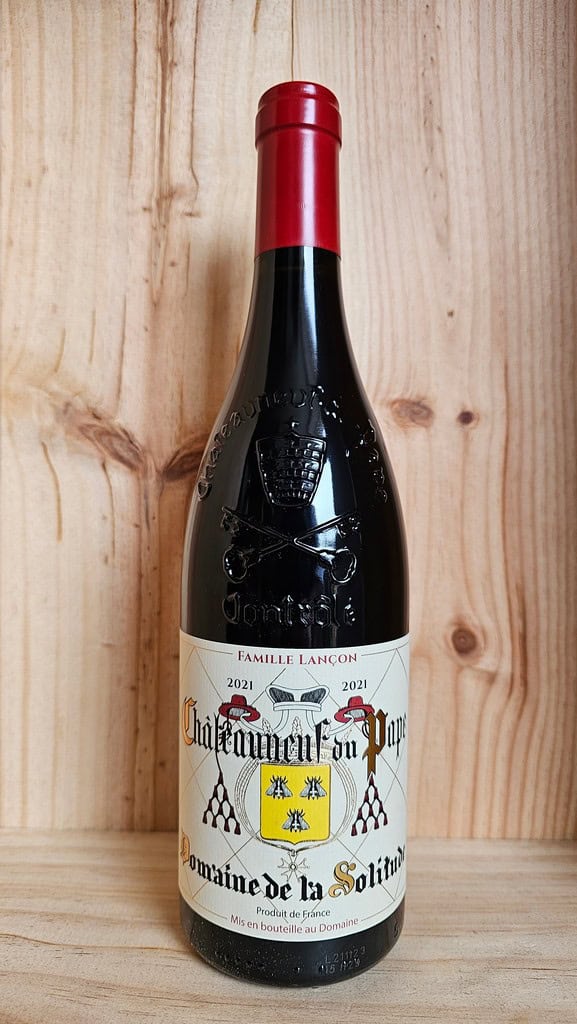
Domaine de la Solitude is a true titan of Châteauneuf-du-Pape. Steeped in a winemaking legacy that stretches back to the 13th century, it is revered as one of the appellation’s most historic and legendary estates. This venerable house crafts quintessential Southern Rhône reds that seamlessly bridge timeless tradition with refined elegance.
At Fareham Wine Cellar, we are delighted to offer their benchmark Châteauneuf-du-Pape Rouge – a masterful expression of heritage, exceptional terroir, and classic Rhône character.
Blend (2023 Vintage)
Dietary & Certification
Domaine de la Solitude comprises some 38 hectares in the Châteauneuf-du-Pape appellation. It has some of the region’s best terroirs, with soils rich in rounded quartzite stones from the Villafranchian period. These famous vineyard stones absorb heat during the day and radiate it at night, promoting full grape maturity.
Winemaking at Domaine de la Solitude began in 1264 when the Italian Barberini family arrived from Tuscany to serve the pope in Avignon. Eventually, a daughter of the family, renamed Barberin to sound more French, married into the Martin family, winemakers in the area. The Martin family were the first to sell the wine as “Vin de la Solitude”, way before Châteauneuf-du-Pape existed.
Today, their descendants, the Lancon Family, still own and manage the estate. Brothers Jean and Michel Lancon are in the process of handing over the reins of the business to Michel’s son, Florent. Florent is an innovator who also respects the centuries of tradition at the estate. Recently, Florent has acquired some tulip-shaped concrete vats initially designed for Cheval Blanc, which are at the cutting edge of wine-making technology.
Domaine de la Solitude Chateauneuf-du-Pape Rouge is a rich and opulent wine with ripe blackcurrant aromas layered with notes of the garrigue and cistus flowers. Full-bodied but with a soft texture and characteristic elegance, the ripe fruits combine with notes of cocoa, cherry and a hint of liquorice on the finish.
This is the perfect match for a slow-cooked should of lamb stews, dishes with mushrooms and many cheeses.
It always used to be a well-known fact in the wine world that, traditionally, wines from Chateauneuf du Pape could be produced from a blend of up to 13 different grape varieties. In fact, since the Chateauneuf du Pape AOC rules were rewritten in 2009, there are 18 varieties permitted with white, pink and black varieties of the same grape now listed separately. Both red and white grape varieties can be used in both the red and the wines.
The 18 grapes are Cinsault, Counoise, Grenache noir, Mourvèdre, Muscardin, Piquepoul noir, Syrah, Terret noir, and Vaccarèse (Brun Argenté). White and pink varieties are Bourboulenc, Clairette blanche, Clairette rose, Grenache blanc, Grenache gris, Picardan, Piquepoul blanc, Piquepoul gris, and Roussanne.
Reviews
There are no reviews yet.