

Whether you’re planning a milestone celebration or simply want to know why a Methuselah is different from an Imperial, this is your complete guide to large-format wine bottles. At Fareham Wine Cellar, we stock a carefully selected range — from Magnums of Vintage Port to Imperial Bordeaux — and we’ve been helping customers choose the right bottle size for over 30 years.
Over the Christmas period, a customer asked me why wineries bother to bottle wines in large format wine bottles such as a Double Magnum or Magnum. I didn’t have an immediate answer for him at the time, but there are a good few reasons.
The key factor is the air-to-wine ratio. In a Magnum, this ratio is closer to ideal than in a standard 75cl bottle, allowing the wine to age more slowly, more gracefully, and more consistently. A Magnum of a great Bordeaux will often outlive and outperform the same wine in a standard bottle by ten or more years.
Conversely, the high air-to-wine ratio in a half bottle means wines age faster — best enjoyed within a few years rather than cellared for the long term.
There is something genuinely ceremonial about opening a Magnum or Double Magnum at a dinner table. A single Magnum served to a table of six or eight means everyone drinks from the same bottle. Fair warning: anything larger than a Double Magnum can require two people to pour.
Large format Champagne bottles in particular, are sold as much for the impression they make as for what’s inside. A Jeroboam of vintage Champagne arriving at the table is a moment. A Methuselah is an event.
This is the main argument for the bottling of larger formats of wine bottles: Magnums of wine are said to be the optimum size of wine bottles for ageing wine. The air-to-wine ratio (amount of air in the bottle to the volume of wine in the bottle) is supposed to be just about perfect to allow the wine to gently and slowly age to maturity when compared with smaller bottles. Large format bottles of Bordeaux are often favoured by Bordeaux collectors for this reason. Conversely, if you think about it, the ratio of air to wine in a small half-bottle is quite high and therefore wines in half-bottle tend to age more quickly. Therefore, half bottles are not the best size for maturing wine for long periods of time.
I have heard people say that it is easier to serve wines at a dinner party or function in a Magnum or a Double Magnum. This could be true. It is certainly sometimes desirable to let everyone drink from the same bottle so that it is a properly shared experience. However, anything larger than a Double Magnum can be quite tricky to serve; the bottles are quite cumbersome and difficult to handle – it might become a two-man job just to pour a bottle. This may not be such a problem if you have a ready supply of wine waiters. Indeed, I once was at a birthday party where a Nebuchadnezzar of Champagne (15 litres or 20 standard bottles of wine) was served, and it took three men to pour it!
Lots of Champagne is sold in large format bottles, and I think this can be put down to the fact that they are impressive and make a certain statement, but don’t forget, you are going to need a pretty big space in your fridge or a dustbin to serve as an ice bucket to chill the Champagne down. They are also not the easiest of things to open. Unlike red wines that are usually bottled at the time of vintage, large formats of Champagne are quite often filled from standard bottles just before shipping and sale.

Champagne Armand de Brignac bottles their famous Ace of Spades Champagne in a range of large-format bottles and now produces one in a rather massive Champagne bottle that contains 30 Litres and is known as a Midas – holding the equivalent of 40 standard bottles.
As well as the Midas format from Brignac, there are some other recent additions to large format Champagne bottles with the bottlings by other producers variously known as the Solomon, Sovereign and the Primat or Goliath with sizes of 18L, 26.25L and 27L.
The naming system for large format bottles is genuinely confusing — it differs between Bordeaux and Burgundy/Champagne, which means the same size bottle carries two different names depending on the wine inside. The key one to remember: a 3-litre bottle is a Double Magnum in Bordeaux but a Jeroboam in Champagne and Burgundy. And a Jeroboam in Bordeaux is a different size altogether – 4.5 litres. The list below covers the most commonly encountered formats, but it is not exhaustive.
It is also worth noting that not all unusual bottle sizes are large. Port and Madeira are frequently sold in 50cl formats, and dessert wines, where smaller servings are the norm, commonly appear in 37.5cl half bottles, 50cl half-litre bottles, and occasionally 20cl quarter bottles. Hungary’s celebrated Tokaji is traditionally sold in 50cl bottles, a format that reflects the wine’s intense concentration and the small quantities in which it is typically enjoyed. Browse our range of dessert wine half bottles if you’re looking for something in a smaller format.
(a) Normally called a Double Magnum in Bordeaux
(b) Normally called an Imperial in Bordeaux
The short answer is hand production. There are no automated bottling lines for formats above Magnum size — every bottle above 1.5 litres is filled, labelled, corked, sealed, and packed by hand, which adds considerable time and cost at every stage. The bottles themselves are significantly more expensive to manufacture than standard 75cl formats, and the corks required for Double Magnums and above are non-standard sizes that must be specially sourced. All of this means that large-format wines carry a meaningful price premium over the pro-rata cost of buying the same wine in standard bottles — though for serious collectors, the superior ageing potential more than justifies the difference.
One practical note worth flagging: if you’re opening a Double Magnum or larger, a standard corkscrew may not be up to the job. Check in advance that you have a lever-style or waiter’s friend with a long enough helix — or ask us in-store and we’ll point you in the right direction.
Current highlights from our large format range:
For bespoke orders, call 01329 822733 or visit us at 55 High Street, Fareham, Hampshire.
What is the most popular large-format wine bottle?
The Magnum (1.5 litres) is by far the most widely available. Most major wine producers, Champagne houses, and Port shippers produce at least some of their range in Magnum. Larger formats are produced in much smaller quantities.
Do wines age better in large format bottles?
Yes – particularly in Magnums, widely regarded as the ideal size for long-term cellaring. Half bottles age faster due to their higher oxygen ratio and are best enjoyed within a few years of purchase.
Are large-format wine bottles a good gift?
A well-chosen large-format bottle makes one of the most memorable wine gifts available – particularly for significant birthdays, weddings, or anniversaries. A Magnum laid down in the year of a child’s birth is a deeply personal gift.
What is the difference between an Imperial and a Methuselah?
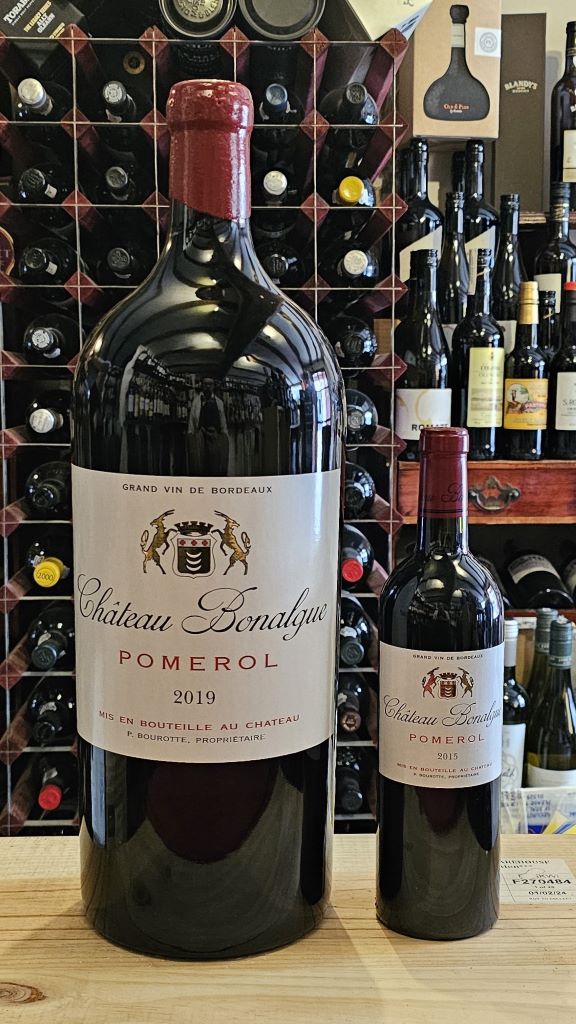
Both contain 6 litres – eight standard bottles. Imperial is the Bordeaux term; Methuselah is used in Champagne and Burgundy. The Château Bonalgue Pomerol Imperial currently available at Fareham Wine Cellar is an excellent example.